
There’s a narrative that’s been running through the business world for the last decade: software eats everything. Build a product. Automate the labour. Scale without limits. Services businesses, by comparison, were the consolation prize—good income (maybe?), but nothing that compounds or creates real enterprise value.
AI was supposed to finish the job. Why hire experts when you can prompt your way to an answer?
It turns out the opposite is true. And if you run a services business— this is the best time in a generation to be doing it.
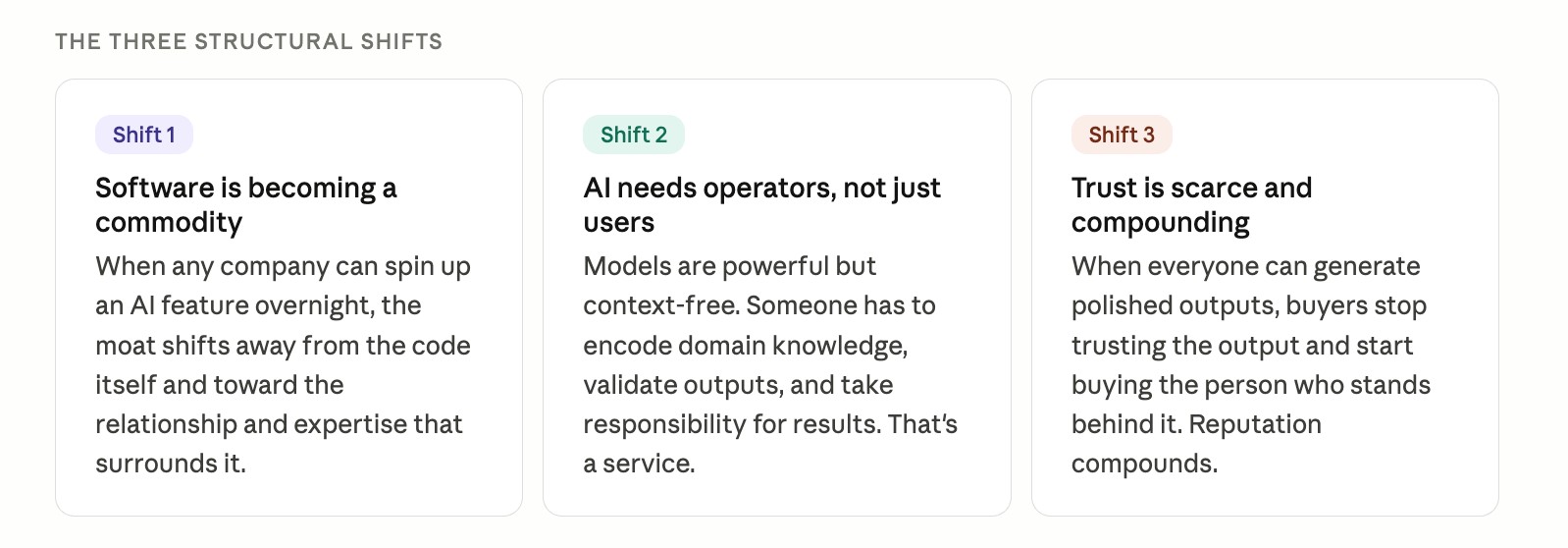
Let me “Tarantino this” for you in a simple model:
 Software just got harder to sell
Here’s what’s actually happening on the product side of the market.
AI has made it faster and cheaper than ever to build software. A feature that used to take an engineering team three months can be prototyped in a week. Entire SaaS categories are being commoditized in real time. The code itself is no longer the moat.
Think about what that means for every software company competing on features. The thing they spent years and millions building can now be replicated by a well-funded competitor—or a scrappy one—in a fraction of the time. Differentiation collapses. Pricing power erodes. Customer Acquisition Costs (CAC) goes up. Sales velocity goes down. The race to the bottom accelerates.
Shopify spent years building infrastructure that merchants depend on. But the “build an e-commerce engine” part of that story is getting less defensible by the month. What Shopify is actually selling now is trust, ecosystem depth, and relationships. That’s not a software story. That’s a services story.
Clio, the Vancouver-based legal tech company, built a dominant position in legal practice management. As AI tools flood the legal software market, Clio’s edge isn’t the features. It’s a decade of law firm data, deep integrations, and the fact that lawyers have built their practices around them. Again—that’s a relationships and trust story.
The companies winning right now are the ones with the deepest expertise and the hardest-to-replace judgment. You know what’s really good at judgement? Humans.
AI is a force multiplier—but only if someone knows what to do with it
Every business owner right now is being told to “use AI.” Most of them are drowning in tools and underwhelmed by results.
The reason is simple: AI is only as useful as the context you bring to it. A model doesn’t know your market, your customers, your competitive position, or where your last three projects went sideways. It knows patterns. You need someone who knows your business.
This is exactly where services businesses are becoming more valuable, not less.
The AI can produce output. It can draft, summarize, analyze, and generate. What it can’t do is walk into a room and understand what’s actually going on. It can’t tell you that the real problem isn’t your pricing—it’s your positioning. It can’t build the relationship that leads to the next engagement. It can’t be held accountable when things go wrong.
Services businesses do all of those things. And now they can do them faster, at higher margin, with better leverage than ever before.
Buyers are more uncertain than they’ve ever been
When every category is moving fast—when your tools, your hiring process, your competitive landscape, and your customer expectations are all shifting at the same time—most business owners don’t want another piece of software to figure out. They want someone who has already navigated the disruption and can tell them what to do.
Uncertainty drives advisory demand. Always has.
In the 2008 financial crisis, consulting firms held up while plenty of product businesses didn’t. During COVID, fractional operators became a primary strategy for companies that needed expertise without permanent overhead. The pattern repeats: when the environment gets harder to read, smart operators buy guidance.
We’re in one of those moments right now. The Canadian tech sector has already been feeling it—companies like D-Wave, Hootsuite, and Wealthsimple have each gone through serious reinvention cycles in recent years. None of them navigated those pivots with a chatbot. They did it with people who understood their business, had seen similar problems before, and were accountable for the outcome.
The same dynamic plays out at every scale. A 20-person professional services firm going through a leadership transition. A 50-person manufacturer trying to figure out their digital strategy. A founder-led business preparing for their first outside investor. The need for trusted, accountable expertise doesn’t disappear when things get complex. It intensifies.
The unit economics finally make sense
I’m gunna say the quiet part our loud: AI has fundamentally changed the math of running a services business.
The old critique was fair. Services don’t scale. Revenue grows with headcount. Margins compress. You add a client, you add a person.
That constraint is breaking down.
A CRO who uses AI tools to run pipeline analysis, forecast modelling, and call scoring can stop living in spreadsheets and spend their time on the deals, the people, and the strategic decisions that actually close revenue.
A lawyer who uses AI to compress contract review, research, and first-draft work can handle more files without adding headcount—and still bill for the counsel that only comes from years in the room.
A marketer who uses AI for research and execution can focus their time on the strategic, creative and commercial decisions that actually move the needle.
What used to take a team of four can now be done by one person with the right systems behind them. That’s not a threat to services businesses. That’s the most significant efficiency gain in the category’s history.
The operators, firms and agencies who are building this now—developing proprietary workflows, AI-assisted delivery, and institutional knowledge that compounds over time—are building moats. Not because the AI is hard to access. It isn’t. But because the context, the processes, and the trust built around it are.
The window is open
The businesses that are going to win in this environment are the ones that figured out how to combine AI leverage with deep expertise—and deliver outcomes at a pace and scale that wasn’t possible before.
To me, that sounds less like the death of services and more like the best version of them.
The model everyone wrote off is having its moment.