When early-stage companies struggle with go-to-market execution, the initial instinct is usually to look at pipeline generation, sales productivity, or marketing channels.
Maybe the messaging isn’t landing. Or the sales team needs better enablement. Marketing needs to run more campaigns or optimize targeting.
Those things matter — but in many cases they’re not the root cause.
More often than I can count, the underlying issue is actually positioning.
If positioning is unclear, every downstream part of the go-to-market motion becomes harder. Sales conversations become inconsistent. Marketing messaging feels generic. Prospects struggle to understand why your product is different, and deals stall against incumbents or the status quo.
Before any company scales demand gen or invests heavily in sales hiring, they need clarity on something more fundamental: where their product sits in the market and why customers should care.
That clarity is what positioning provides.
What Positioning Actually Means
Positioning is often mistaken for messaging, branding, or a tagline on a website.
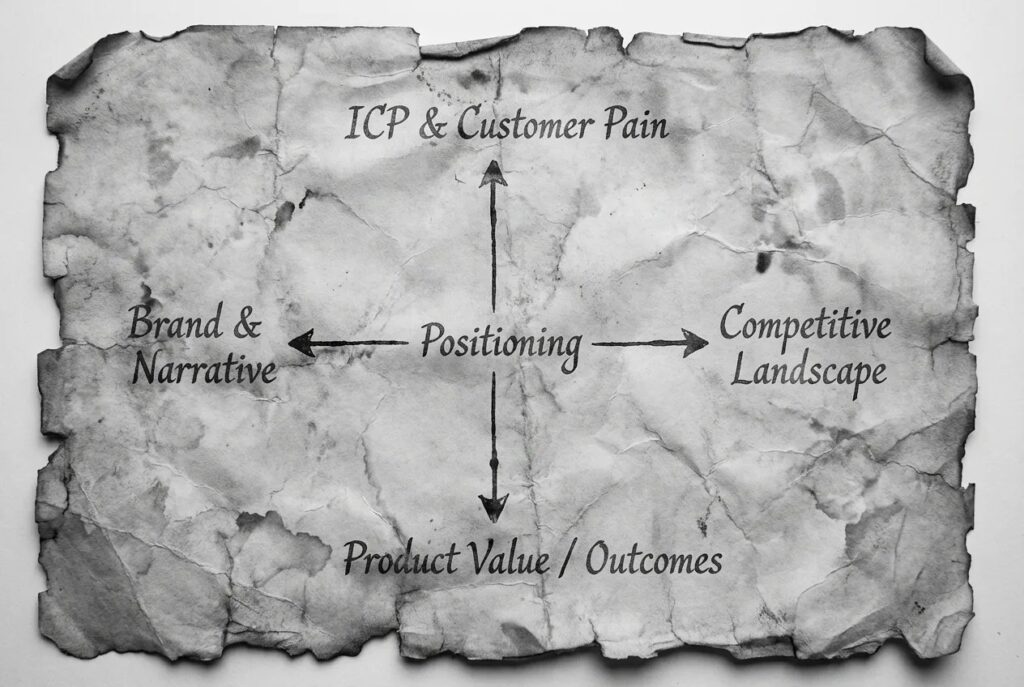
In my mind, positioning sits at the intersection of four key forces:
- Your ideal customer profile (ICP) and their pain points
- Your product and the value it delivers
- The competitive landscape in your category or market segment — including incumbents and the status quo
- Your brand, tone and the narrative you want to own
When these elements align, positioning becomes clear and compelling. When they don’t, even strong products can struggle to gain traction.
Positioning is not about finding clever words to describe your company. It’s about defining the role your product plays in solving a specific problem for a specific customer— and just as importantly, deciding what problems you are not trying to solve.
Start With the Customer
Every strong positioning strategy begins with a deep understanding of the customer.
The most important questions are not just:
- Who buys this product?
- What industry are they in?
More importantly:
- What problem are they trying to solve?
- How urgent is that problem?
- What happens if they do nothing?
That last question is critical because your most common competitor is not another vendor — it’s the status quo.
If the pain isn’t clear or urgent enough, even a well-designed product will struggle to gain traction.
Positioning starts by identifying a customer problem that is both meaningful and solvable.
Translate Product Features Into Outcomes
Once the customer problem is clear, the next step is understanding what your product actually delivers.
Many companies default to describing features or capabilities (technical founders are especially guilty of this!). But effective positioning focuses on outcomes.
Instead of explaining what your product does, ask:
- What measurable improvement does it create for the customer?
- What friction does it remove?
- What business result becomes possible
The stronger the connection between your product and a meaningful customer outcome, the easier it becomes to communicate value.
When positioning is clear, customers quickly understand not just what the product does — but why it matters.
Understand the Competitive Context
Positioning does not exist in isolation. Customers always evaluate products relative to alternatives, whether implicit or explicit.
Those alternatives often include:
- Established incumbents
- Emerging competitors
- Internal solutions
- The status quo (in other words, “just keep doing what we’re doing”)
Understanding how buyers compare these options is essential to defining your position in the market.
Sometimes the strongest position is competing directly against incumbents with a faster, more modern solution. In other cases, the opportunity lies in reframing the problem entirely and creating a new category.
Either way, positioning requires a clear understanding of how customers evaluate their choices.
Align With the Narrative Your Brand Wants to Own
Finally, positioning must align with the story your company wants to tell.
Brand is often misunderstood as design, logos, or visual identity. In practice, brand is closer to the narrative customers associate with your company.
Are you:
- The category challenger?
- The pragmatic alternative to legacy systems?
- The specialist focused on a specific problem?
- A fundamentally new operating model?
Your positioning should reinforce that narrative and make it easier for customers to understand where you fit within the broader market.
Why Positioning Is Often Skipped
In early-stage companies, positioning work is often compressed or skipped entirely.
Teams move quickly from product development to sales and marketing execution. The assumption is that positioning will naturally emerge through customer conversations and experimentation.
Sometimes it does. But more often, companies end up describing themselves in broad or generic terms that fail to differentiate them.
When that happens, go-to-market execution becomes more difficult than it needs to be.
Sales cycles lengthen. Messaging becomes inconsistent. Marketing campaigns generate interest but struggle to convert.
A Simple Test for Positioning Clarity
One useful exercise is to ask three simple questions across your leadership team:
- Who is this product specifically for?
- What problem does it solve better than existing alternatives?
- Why should a customer choose it instead of the status quo?
If the answers vary widely depending on who you ask internally, positioning likely needs refinement.
Clear positioning aligns not just marketing and sales, but product development and leadership decision-making as well.
Final Thought
At BrightIron, we often see companies invest heavily in demand generation or sales hiring before fully clarifying their market position.
Taking the time to pressure-test positioning early can dramatically improve the effectiveness of everything that follows.
In many cases, what looks like a go-to-market problem is actually a positioning problem.